 Sluit menu
Sluit menu
Sluit menu
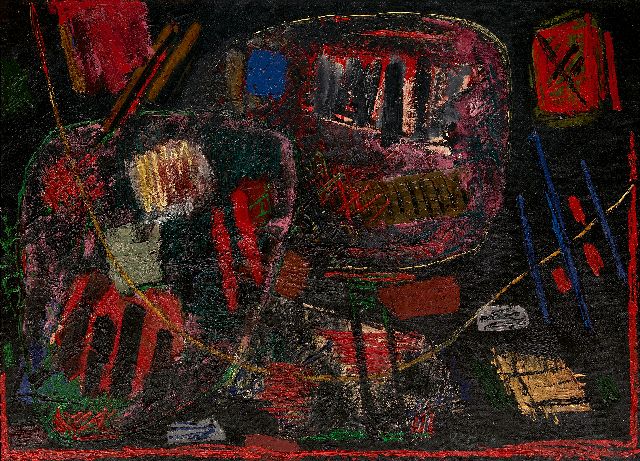
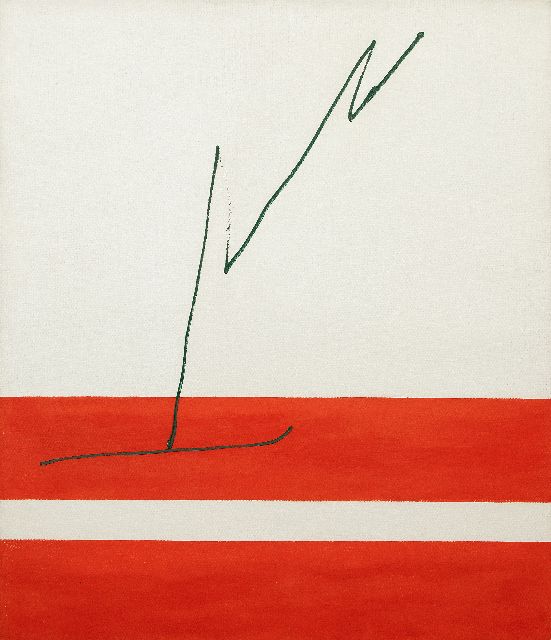
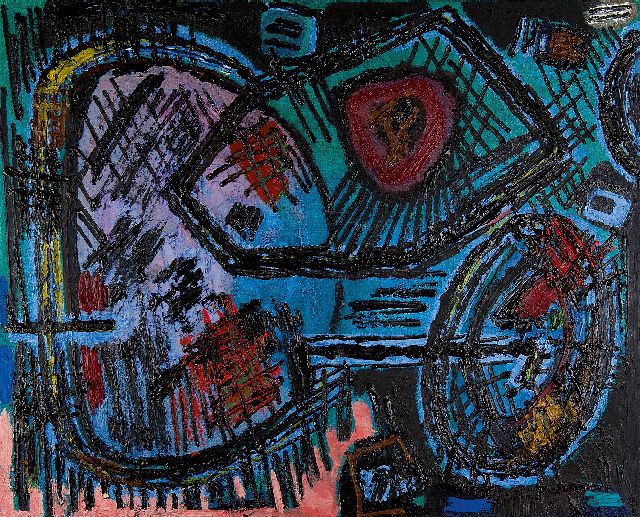
Rotterdam poet-artist Willem Hussem briefly attended the Rotterdam Academy and then apprenticed with graphic artist Dirk Nijland. Hussem later preferred to call himself self-taught. After completing his studies, he moved to Paris in 1918, as many artists did at the time, and settled briefly in the capital, Villeneuveles-Avignon, until 1929. Back in the Netherlands, he married and lived with his family from 1933 to 1936 near Paris, where he encountered Picasso and Mondrian. In 1936, still working figuratively, he returned to the Netherlands, where he settled in The Hague's Schilderswijk district. The years in The Hague, shortly before and during World War II, were of great significance to Hussem's development as an artist. During this time, he created his first non-figurative paintings and later, during World War II, graphic works in ink on paper due to a shortage of painting supplies. It was during this time that his literary activity also arose during visits to the Hague artists' cafe De Posthoorn, where he met not only painters and other friends, but also several writers. From that time on, his search for a unique style began, with free, expressive forms, striving for simplicity and purity. This stemmed from his need for clear systems of thought, for which he found inspiration in the philosophy of Hegel and Zen Buddhism. In the 1950s and 1960s, this ultimately resulted in a recognizable style with balanced compositions of lines, with strong areas of colour and shapes on a monochrome background.
Hussem was a member and key figure of the Hague Posthoorn Group. In 1949, he joined Vrij Beelden (Free Images), and in 1960, he became a member of the Hague painting group Fugare, whose members opposed the 'coincidence' of abstract expressionism, particularly that of the Cobra group. Throughout his life, he continued to search for a working method that aligned with his philosophical views, both in his painting and his poetry. His poetry often consisted of short poems, and in his painting, he ultimately found his own geometric, abstract style through expressionism and constructivism.