 Sluit menu
Sluit menu
Sluit menu
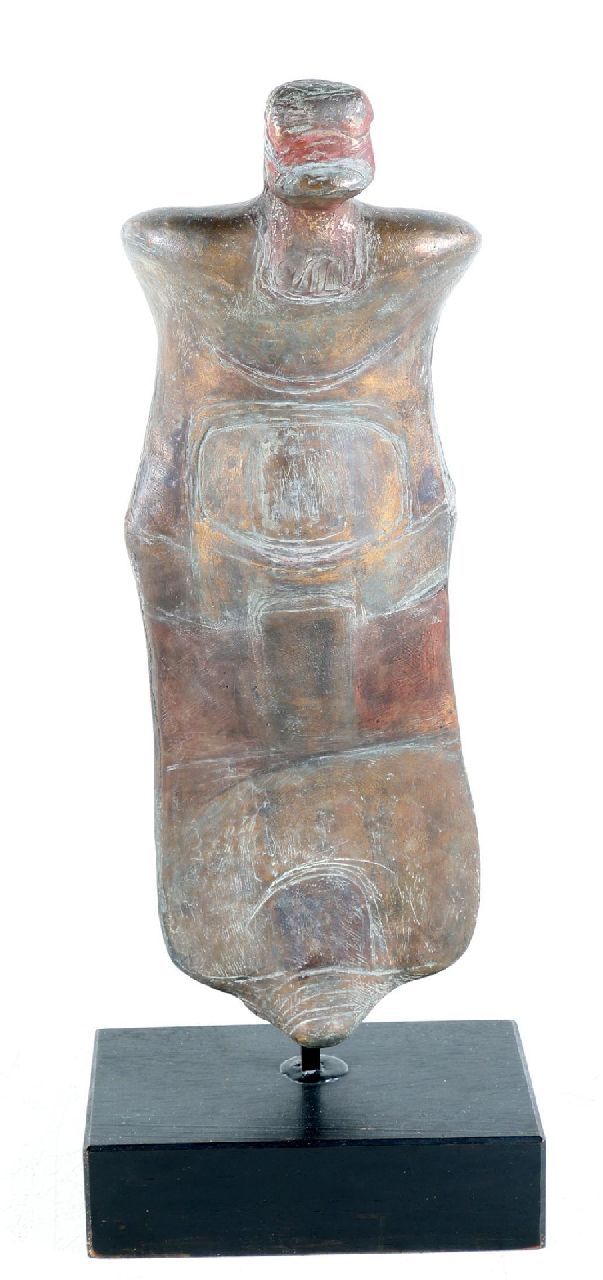
Sculptor Hetty 'Fioen' Blaisse-Kramer grew up in a musical family – her father was a violinist with the Concertgebouw Orchestra and her mother a pianist. Despite learning to play the violin at an early age, she chose to pursue a career as a visual artist. She spent a year studying portrait sculpting at the Teacher Training School in Amsterdam. Between 1956 and 1958, she worked under the guidance of sculptor Paul Koning in his studio, and after marrying Erik Blaisse, she began studying sculpture at the Institute for Applied Arts Education (later the Gerrit Rietveld Academy). Exhibitions soon followed, including at the Genootschap Kunstliefde in Utrecht and exhibitions organized by the Dutch Circle of Sculptors. After graduating in 1961, she opened her own studio in Wittenburg, where she continued to work until her death. Initially, she created many portraits commissioned by private individuals, but increasingly, commissions came from government agencies for sculptures in public spaces for various cities in the Netherlands. During a trip to Tunisia in 1970, she became fascinated by the traditional dancers dressed in light, airy fabrics, performing their dance with supreme concentration. From that time on, images of these women became an important and recognizable theme in her work. Blaisse-Kramer set high standards for herself, sometimes working for months on a sculpture that, in her view, had to have its own expressiveness by 'looking into a world of its own.' She continued to choose figuration throughout her life, even at a time when abstraction prevailed, but nevertheless developed her own innovative visual language. In 1998, she received the Singer Prize for her complete oeuvre as a sculptor, with a retrospective exhibition at the museum. She continued to play the violin throughout her life, including in string quartets.