 Sluit menu
Sluit menu
Sluit menu
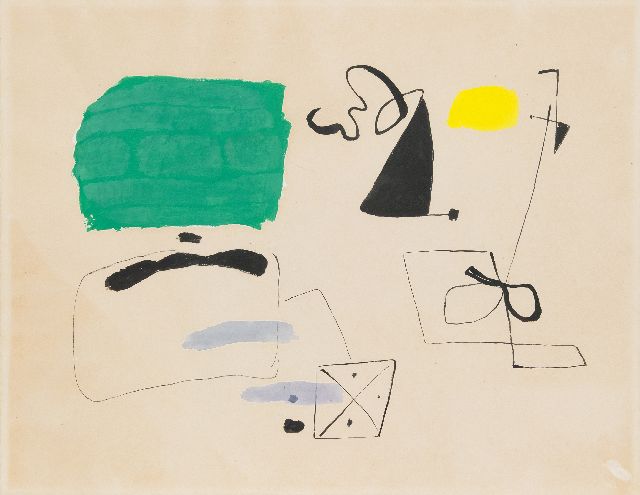
Piet Ouborg came from a strict Calvinist family. This set the tone for the children's education. For Piet, this became training to be a teacher. When the First World War broke out, he avoided conscription by choosing to be sent to the Dutch East Indies as a civil servant, where he began working as a teacher and art instructor in 1916. He remained there until 1938, a period that was crucial to his artistic development. Despite his demanding job, he began free-style painting, initially studies and drawings of Indonesian models and landscapes. But Ouborg increasingly sought to follow new movements and developments in European art, as far as this was possible far from home. During his leave periods in the Netherlands, he caught up. After his first leave in 1923, he experimented with work in the Cubist style and the style of the Bergen School. During his second leave in 1931 in Brussels, he saw the work of the Surrealists and was particularly drawn to the paintings of Joan Miró.
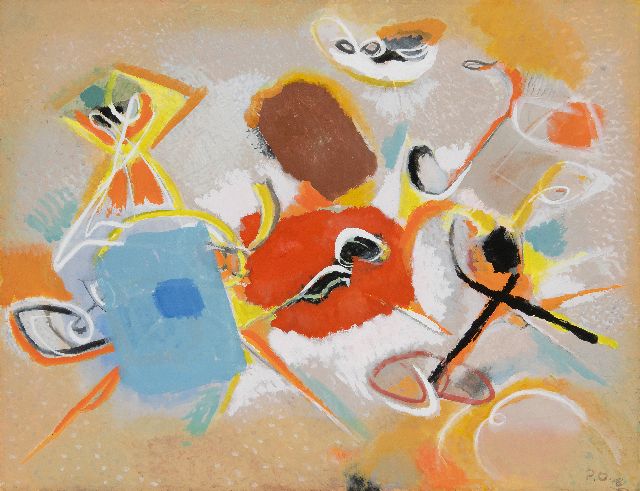
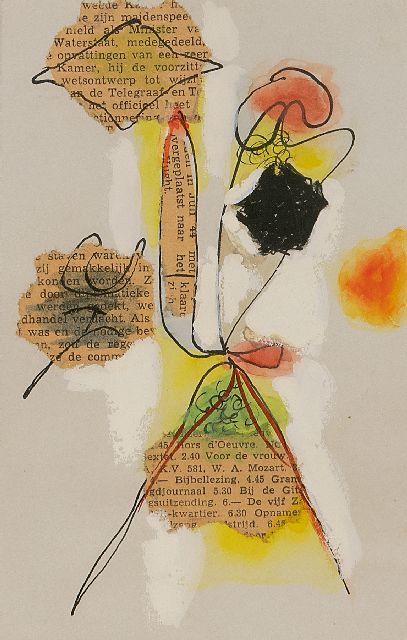
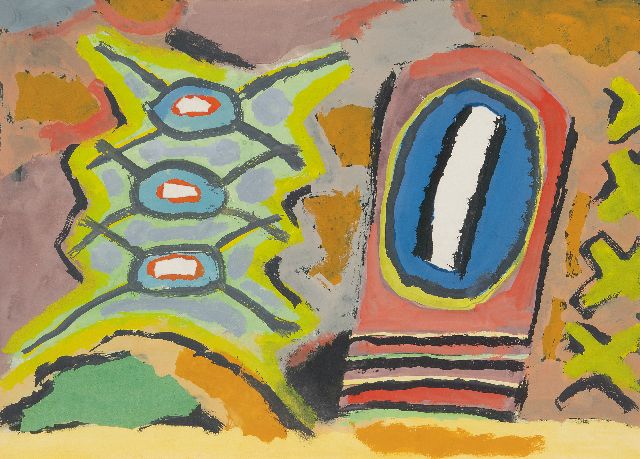
Ouborg, interested in the world beyond visible reality, quickly embraced the figurative and abstract visual language of Surrealism. After his definitive return to the Netherlands in 1938, his fascination with the magical tropical world persisted. The abstracted work he created was imbued with Indonesian motifs. Whimsical forms of roots, dancers, demons, and exorcists can be recognized in many of Ouborg's expressive, semi-abstract paintings. After a short time in Haarlem and Amsterdam, he settled in The Hague, where he began teaching art history and drawing. During World War II, he came into contact with future members of the CoBrA movement, the painters Karel Appel and Corneille, and with Willem Hussem and Jaap Nanninga, later members of the Posthoorn Group and the New Hague School.
In 1945, Ouborg retired from teaching and devoted himself entirely to his artistry. He finally became convinced that he was a painter, not just a schoolteacher passionately pursuing a hobby in his spare time. In 1947, he participated in an exhibition of the Experimentelen group at the Hague Art Circle and joined Pulchri Studio, Vrij Beelden (Free Images) (1947-1955), and the Liga Nieuw Beelden (New Images League) (1955-1956). He gained recognition among colleagues and was asked by Appel, Constant, and Corneille, who considered Ouborg an artistic kin, to join their CoBrA group. But in a letter dated October 23, 1949, the introverted Ouborg replied: 'I won't participate. I don't feel like much of a group person.'
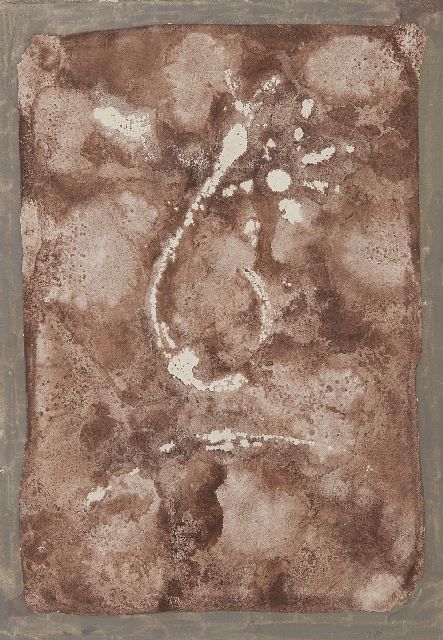
Ouborg's fame grew rapidly, culminating in a controversy surrounding the 1950 award of the Jacob Maris Prize for his drawing 'Father and Son.' In the post-war art world, the acceptance of modern art in the Netherlands was slow to gain traction. Appel experienced this firsthand, but Ouborg also faced a barrage of criticism for his award-winning abstract drawing. Ouborg's style evolved throughout his artistic career, developing his own interpretation of surrealism that gradually evolved into abstract expressionism. This definitively places him among the small group of champions of modern art in the Netherlands.